/pages/posts/xenofeminism-and-top
From Bourbaki to Xenofeminism (Or, The Unintentional Structuralism of Tyler Joseph)
From Bourbaki to Xenofeminism: Or, The Unintentional Structuralism of Tyler Joseph
Section titled “From Bourbaki to Xenofeminism: Or, The Unintentional Structuralism of Tyler Joseph”On mathematical collectives, anagrammatic reversals, and what happens when a pop star accidentally writes accelerationist theory.
0. The Anagram That Shouldn’t Work
Section titled “0. The Anagram That Shouldn’t Work”Somewhere between a graduate seminar in category theory and a Twenty One Pilots concert in Cincinnati, there exists a Venn diagram overlap that feels almost deliberately absurd. Nicolas Bourbaki — the collective pseudonym of a group of French mathematicians who attempted to rebuild all of mathematics from set-theoretic foundations — reappears, nearly a century later, as the name of a xenofeminist collective operating across five countries and three continents. The transformation is simple: scramble the letters. Laboria Cuboniks. An anagram so perfect it feels like it should mean something occult, like the kind of cipher you’d find in a Borges story or a Discordian prank.
But the anagram is only the surface. The deeper joke — the one that makes this worth more than a cocktail-party trivia fact — is that Bourbaki also appears, with almost no one noticing, as the “real name” of Nico, the primary antagonist in Twenty One Pilots’ decade-long narrative universe. Blurryface, Tyler Joseph’s personification of insecurity and depression, gets christened Nicolas Bourbaki in the album Trench. The same name that a group of mathematicians used to publish their collective work. The same name that a feminist collective would later anagrammatize into a manifesto for gender abolition.
What connects these three uses — mathematical, musical, and political — is not just a name. It is a shared commitment to structural thinking, to the idea that individual identity is less important than the systems that produce it, and that the most radical act might be to dissolve the self into a collective project. What Tyler Joseph almost certainly did not realize, when he pulled Bourbaki from the murk of his creative process, was that he was tapping into a philosophical thread that would lead directly to one of the most ambitious feminist projects of the twenty-first century. This essay is about that thread: how a name travels from mathematical structuralism through pop-music mythology and emerges, transformed, as a politics for alienation. And how, in the process, Tyler Joseph accidentally became a kind of xenofeminist.
1. Bourbaki and the Architecture of Nothing
Section titled “1. Bourbaki and the Architecture of Nothing”The Bourbaki collective began in 1934, when a group of young French mathematicians — mostly alumni of the École Normale Supérieure — decided that mathematics had become too fragmented. Their solution was radical: they would rebuild the entire edifice of modern mathematics from the ground up, using a uniform structuralist approach, and they would publish their work under a collective pseudonym borrowed from a little-known French general of the Franco-Prussian War. (Quanta Magazine) The name was arbitrary in origin — the result of a student prank — but it became, over decades, one of the most influential authorial fictions in intellectual history. (wikipedia.org)
Bourbaki’s methodology was as important as their mathematics. Every volume of their monumental Éléments de mathématique was produced collectively: individual members drafted chapters, which were then subjected to withering criticism at group meetings, revised, criticized again, and only eventually published under the shared name. (אוניברסיטת ת”א) The process was deliberately anonymous. Membership was confidential. The group’s internal bulletin, La Tribu, circulated minutes filled with private jokes and obscure references, but never with individual attributions. (אוניברסיטת ת”א) As historian Michael Barany has noted, Bourbaki’s “personhood was often fleeting” — the collective existed as a kind of structural void, a name that was simultaneously empty and enormously productive. (nih.gov)
The Bourbaki group’s most philosophically significant contribution was not any single theorem but their concept of mathematical structure itself. They identified three “mother structures” — algebraic, topological, and order-theoretic — from which all of mathematics could, in principle, be derived. (Western University Publish) This was structuralism as a creative methodology: not just the study of structures, but the conviction that structures are prior to the objects that instantiate them. A group is not a collection of numbers with certain properties; it is a structure that can be realized by numbers, by symmetries, by transformations — by anything that satisfies the axioms. The particular content matters less than the relational architecture.
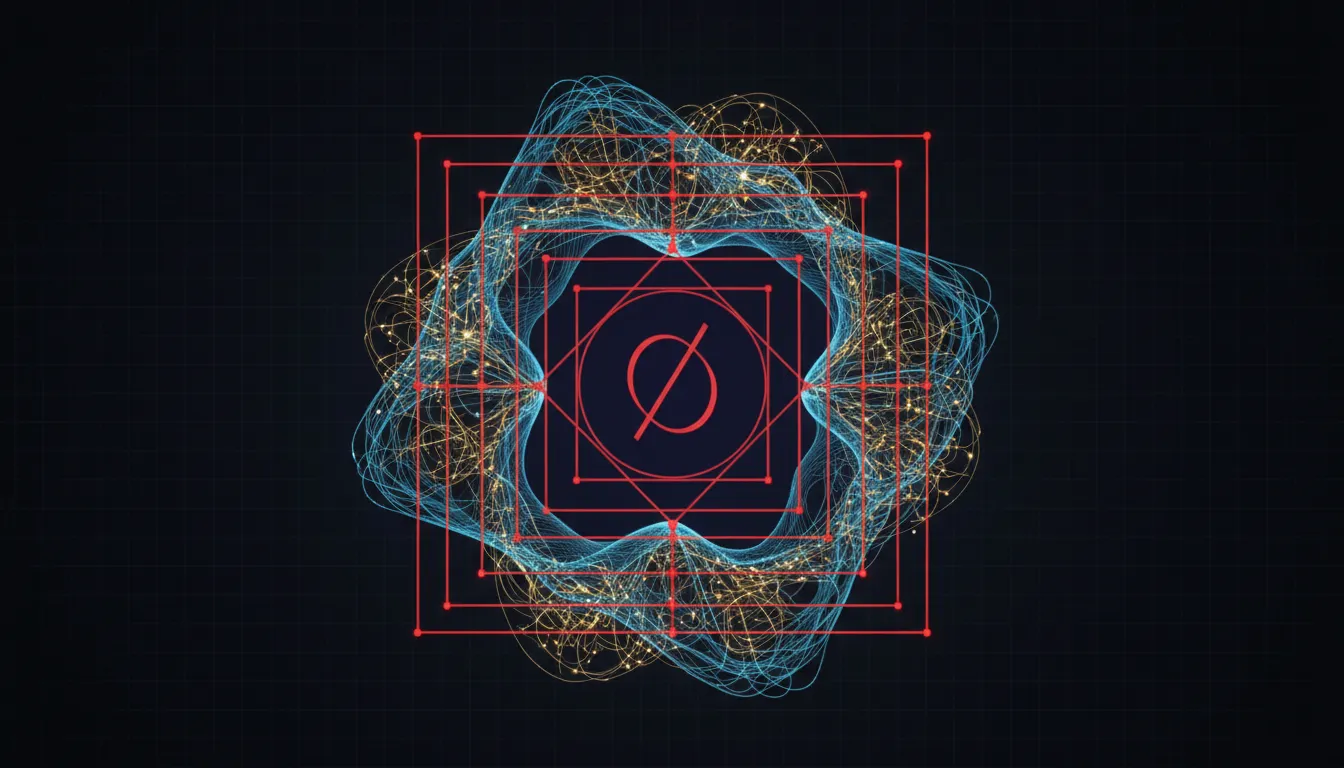
And then there is the empty set. In 1939, André Weil introduced the symbol Ø — borrowed from the Danish and Norwegian alphabet — to represent the unique set containing no elements. (wikipedia.org) The empty set is a structure that contains nothing, yet it is not nothing. It has cardinality zero, but it exists. It is the foundation from which all other sets can be constructed: the number zero is defined as the empty set, one is the set containing the empty set, two is the set containing both, and so on, in a recursive tower that eventually produces all of mathematics. (Double Torus) The empty set is, in this sense, the ultimate structuralist object: pure form without content, a vessel that carries meaning precisely because it carries nothing.
This concept — the vessel that is empty yet foundational — would resonate far beyond mathematics. It would become the title of a Twenty One Pilots album. It would become the philosophical ground of a religion practiced in a fictional city called Dema. And it would become, though no one planned it, a metaphor for the kind of identity that xenofeminism would later demand: not the self as essential substance, but the self as open structure, available for reconstruction.
2. Nico and the Architecture of Fear
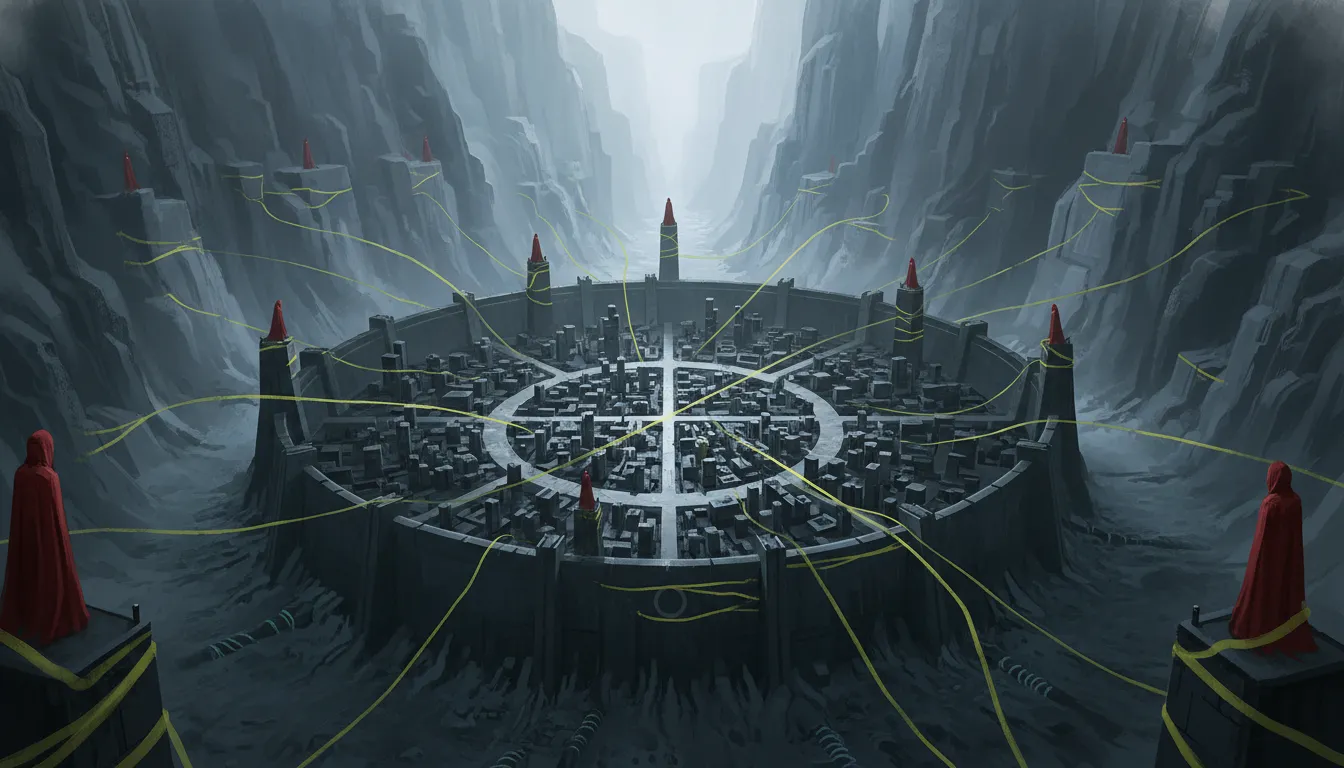
Section titled “2. Nico and the Architecture of Fear”In 2018, Tyler Joseph revealed in an interview that Blurryface — the red-eyed, black-handed manifestation of anxiety that had haunted the band’s previous album — had a real name. “Nicolas Bourbaki,” Joseph explained. “He’s got no friends close, but those who know him most know. He goes by Nico.” (Music Feeds) The name appears in the song “Morph,” nestled in a verse about transformation and escape, and it anchors the entire mythology of Trench and its successor albums. Nico is the leader of the nine Bishops who govern Dema, a walled city at the bottom of a world called Trench. He is also, we are told, Blurryface itself — the same entity, operating under different names and guises. (fandom.com)
The choice of Bourbaki as Nico’s “real name” is, on its face, a piece of typically dense TØP worldbuilding. Joseph has acknowledged that he knows more about Bourbaki than the average fan might assume; the band’s cryptic pre-release campaign for Trench included a photograph of André Weil, Bourbaki’s founder, standing beside a young boy who fans would later identify as part of the Dema mythology. (neverendingbooks) But the deeper logic of the choice reveals something more interesting than simple Easter-egg hunting. By naming his villain after a mathematical collective, Joseph was doing something structurally sophisticated — even if he didn’t fully articulate it in those terms.
Blurryface, as Joseph has repeatedly explained, is not a single fear but a collective of insecurities: anxiety about his art, anxiety about his voice, anxiety about his body, anxiety about whether any of it matters. (hypercritic.org) “My name’s Blurryface and I care what you think,” goes the refrain from “Stressed Out” — a statement that simultaneously names the entity and dissolves its specificity. Blurryface is everyone and no one. It is the chorus of internal critics that speaks with a single voice but has no single source. Naming this entity “Nicolas Bourbaki” — the name of a collective that published as a single author — is therefore not just clever wordplay. It is a structural homology. Bourbaki, the mathematical collective, speaks as one person while being many. Blurryface, the psychological collective, speaks as one person while being many. The name formally encodes what the character represents.
But there is more. Bourbaki’s mathematical project was built on set theory, the study of collections and their intersections. The intersection of two sets — the elements they share — is one of the most basic operations in the field. And intersectionality, though Bourbaki would never have used the term, is precisely what Blurryface represents: the overlapping, compounding nature of psychological oppression, where anxiety about one’s art intersects with anxiety about one’s body intersects with anxiety about one’s faith, producing a subject who is not merely anxious but structurally, systemically trapped. (reddit.com) Tyler Joseph almost certainly did not intend this connection. But the structural logic of his own creation pushed him toward it. When you name a collective of fears after a collective of mathematicians who studied intersections, something is going to leak through.
The world of Dema extends this structural logic into full-blown social theory. Dema is a city organized around Vialism, a religion that teaches its citizens to view themselves as empty vessels waiting to be filled — and ultimately, to view death as the highest fulfillment. (Alternative Press Magazine) The “Glorious Gone” are those who have committed suicide under Vialist doctrine; their bodies become “available vessels” for the Bishops to possess through psychokinesis. (reddit.com) The system is brutally elegant: the religion convinces you that you are nothing, and then it uses your nothingness as a resource. The empty set, transformed into a mechanism of control.
Joseph has described Vialism as “the antagonist of this story” — not the Bishops, not Nico, but the system itself, the structural arrangement that makes all of it possible. (Alternative Press Magazine) This is a profoundly structuralist insight. The enemy is not any individual villain but the architecture of relations that produces villainy as an emergent property. You cannot defeat Nico by killing Nico, because Nico is a position in a structure, not a person. The position will always be filled. The structure will always regenerate its agents. This is why the story’s ending — which we will return to — is so philosophically devastating.
3. The Unintentional Xenofeminism of Tyler Joseph
Section titled “3. The Unintentional Xenofeminism of Tyler Joseph”Xenofeminism, as articulated by the collective Laboria Cuboniks in their 2015 manifesto, is a politics built on several core commitments: anti-naturalism (the rejection of “nature” as a justification for inequality), technomaterialism (the embrace of technology as a tool for emancipation), gender abolition (not the erasure of difference but the dismantling of the categories that pre-determine what differences are allowed to exist), and — most provocatively — alienation as liberation (the claim that being estranged from one’s “natural” self is not a problem to be solved but a condition to be accelerated). (Cleveland Review of Books) The manifesto’s famous closing line — “If nature is unjust, change nature!” — is not a call to return to some authentic organic state but a demand to treat the body, gender, and even the human itself as sites of ongoing technological and political intervention. (Trans Reads)
Tyler Joseph has never, to my knowledge, expressed any familiarity with xenofeminist theory. He is a Christian from Columbus, Ohio, who writes pop songs about mental illness. And yet the world he constructed across five albums — from Blurryface through Breach — systematically produces themes that read, with almost eerie precision, like a xenofeminist parable. This is what I mean by unintentional xenofeminism: not that Joseph holds xenofeminist political commitments, but that the structural logic of his creative project generates outputs that parallel xenofeminist theory in ways that cannot be dismissed as coincidence. The parallel is too consistent, too formally precise, to be accidental. Something in the Bourbaki name — or something in the structuralist methodology it represents — opened a door that Joseph walked through without knowing where it led.
Consider the evidence. Xenofeminism is anti-naturalist: it rejects the idea that biology is destiny, that “natural” categories of gender or embodiment should constrain our political imagination. (entropie) Joseph’s entire Dema mythology is built on a parallel rejection. Vialism, the naturalized religion of Dema, teaches that citizens should accept their place in the “natural” order — accept that they are vessels, accept that their purpose is to be filled and then emptied, accept that escape is a violation of divine law. (Alternative Press Magazine) The Bishops are the priests of this naturalism, and the Banditos — the rebels who wear yellow tape and operate in the wild spaces of Trench — are the anti-naturalists, the ones who refuse to accept the given order and demand the right to re-engineer their own existence. When Clancy, the protagonist, first escapes Dema, he is not just leaving a city; he is leaving a naturalized system of oppression, a structure that has been successfully disguised as the way things simply are.
Xenofeminism is technomaterialist: it sees technology not as an alien imposition on the human but as a continuous extension of the human capacity for self-transformation. (medium.com) The Dema mythology is saturated with technology-as-emancipation. Clancy’s power of psychokinesis — the ability to seize control of other bodies, to project his consciousness beyond his own physical form — is a literal technological fantasy of bodily transcendence. (reddit.com) The “Neds,” creatures whose antlers can be removed to grant psychokinetic abilities, represent creativity itself as a kind of bio-technology: a natural resource that can be harvested, weaponized, and repurposed in the struggle against oppression. (MELODIC Magazine) Even the Bishops’ power of “seizing” — possessing the bodies of the dead — reads as a dark mirror of the xenofeminist demand for technological intervention into reproduction and embodiment. The Bishops use body-hopping as a tool of control; Clancy eventually learns to use it as a tool of liberation. The technology is neutral. The politics is in how it is deployed.
Xenofeminism demands gender abolition — not the elimination of gendered expression but the elimination of the structural categories that pre-determine which expressions are legitimate. (beautypapers.com) Here the parallel becomes almost uncomfortable. Blurryface, as a character, is a genderless entity. It is played by Tyler Joseph, but it is not “male” in any meaningful sense; it is a black-painted abstraction, a collection of anxieties that could belong to anyone. The Bishops, too, are essentially genderless — nine red-robed figures whose individual identities matter less than their structural function. And the ultimate revelation of the Dema story — that Clancy, having defeated Nico, becomes the new Nico, dons the red robes, and transforms into the Nova Bishop — is a narrative of gender abolition in the most literal sense. (MELODIC Magazine) The protagonist does not defeat the system by remaining himself. He defeats the system by becoming the position that the system requires, by occupying the structural slot so completely that the structure itself is revealed as empty, as arbitrary, as something that could be filled by anyone. Clancy’s face turns black. He becomes Blurryface. The cycle begins again, but with a difference: “The fight never ends, but it gets a little bit easier each time. Two steps forward, one step back.” (reddit.com)
This is, in essence, the xenofeminist strategy applied to psychological oppression rather than gender oppression. If nature is unjust, change nature. If the structure produces the enemy, become the enemy and thereby reveal the structure’s emptiness. Joseph did not set out to write this. But the structuralist logic of his own creation — the logic he activated when he named his villain Bourbaki — propelled him toward it inevitably.

4. Laboria Cuboniks: The Anagrammatic Reversal
Section titled “4. Laboria Cuboniks: The Anagrammatic Reversal”In 2014, six women — Diann Bauer, Katrina Burch, Lucca Fraser, Helen Hester, Amy Ireland, and Patricia Reed — met at a workshop in Berlin organized by philosophers Armen Avanessian, Reza Negarestani, and Peter Wolfendale. (parrhesiajournal.org) They came from different fields: art, architecture, philosophy, digital music, cybersecurity. They were spread across five countries and three continents. And they decided to form a collective, publishing under a shared pseudonym that was simultaneously a mathematical joke and a political statement.
Laboria Cuboniks is an anagram of Nicolas Bourbaki. The transformation is exact: every letter in the mathematicians’ pseudonym reappears in the feminists’ name, scrambled into a new order. (berlinerfestspiele.de) But the anagram is doing more than hiding a reference. It is performing a structural inversion. Where Bourbaki sought to unify mathematics through abstraction, generality, and rigor, Laboria Cuboniks seeks to dismantle gender through the same tools — abstraction as a weapon against essentialism, generality as a refusal of identity politics, rigor as a feminist methodology. (hesge.ch) Where Bourbaki’s collective pseudonym allowed a group of men to speak as one universal mathematician, Laboria Cuboniks’ collective pseudonym allows a group of women to speak as “no one in particular” — to claim the universal voice that has historically been denied to them. (uberty.org)
The Xenofeminist Manifesto — published online in 2015 and later by Verso Books — is organized into seven sections with programmatic titles: Zero, Interrupt, Trap, Parity, Adjust, Carry, Overflow. (Cleveland Review of Books) The vocabulary is deliberately drawn from computing: these are not chapters but registers, memory addresses in a collective processing unit. The language is “succinct, determined, and streamlined for mobility” — anti-literary, anti-lyrical, designed to function as code rather than poetry. (Cleveland Review of Books) This is the Bourbaki method applied to political theory: strip away the personal, the ornamental, the “natural,” and rebuild from axiomatic first principles.
But the manifesto also inverts Bourbaki in crucial ways. Where Bourbaki sought to establish a single, unified foundation for mathematics — the hierarchy of structures descending from the three mother structures — Laboria Cuboniks seeks to multiply foundations beyond counting. “Let a hundred sexes bloom!” they declare, echoing Mao but twisting the sentiment toward gender proliferation rather than cultural revolution. (metacriticjournal.com) Where Bourbaki’s structuralism was ultimately conservative — a project of consolidation and unification — xenofeminist structuralism is radically disruptive, aimed at producing so many structures that the very idea of structure becomes unstable. “The real emancipatory potential of technology remains unrealized,” they write, and their project is to realize it by accelerating the process of transformation beyond anything capitalism has yet managed. (UAL Research Online)
The collective’s choice to remain anonymous — or semi-anonymous, since their individual identities eventually became known — also mirrors and inverts the Bourbaki model. Bourbaki’s anonymity was a joke that became an institution: the pseudonym started as a prank but eventually became one of the most respected names in twentieth-century mathematics. (nih.gov) Laboria Cuboniks’ anonymity was a political gesture from the outset: a refusal of the celebrity model of authorship, a rejection of the “great woman” theory of intellectual history, and an affirmation of collective production as the only adequate response to structural oppression. (parrhesiajournal.org) As Laboria Cuboniks member Lucca Fraser put it, manifestos are like “stand up comedy… their job is to point things out… to nudge you into adopting a point of view that might not have seemed available beforehand.” (parrhesiajournal.org)
And then there is the anagram itself. An anagram is a reversible transformation: you can always unscramble the letters and return to the original. But in scrambling, something is always gained and something is always lost. Bourbaki becomes Laboria Cuboniks, and in that transformation, mathematics becomes politics, the universal becomes the particular, the male collective becomes the female collective, the project of consolidation becomes the project of dissemination. The anagram encodes, in its very form, the xenofeminist claim that structures are not fixed but transformable — that the same elements, rearranged, can produce radically different outcomes. If nature is unjust, change the letters. If the system produces oppression, scramble the code.
5. Acceleration, Alienation, and the Cycle That Never Ends
Section titled “5. Acceleration, Alienation, and the Cycle That Never Ends”The throughline that connects Bourbaki, Twenty One Pilots, and Laboria Cuboniks is not just a name or a methodology. It is a stance toward change — a particular way of understanding how structures transform, how individuals relate to systems, and how liberation might be possible without falling back into the structures that produced the need for liberation in the first place. This stance has a name in contemporary philosophy: accelerationism.
Accelerationism, in its left-wing variant, argues that the most effective strategy for escaping capitalism is not to resist its tendencies but to accelerate them — to push technological development, automation, and social abstraction so far that capitalism’s own contradictions explode it from within. (wikipedia.org) Nick Srnicek and Alex Williams, in their 2013 “#Accelerate: Manifesto for an Accelerationist Politics,” called for “collectively controlled legitimate vertical authority in addition to distributed horizontal forms of sociality” — a new organizational form that could repurpose capitalist infrastructure for post-capitalist ends. (uberty.org) The left, they argued, had become too focused on local, immediate, “folk political” interventions and had lost the ability to think structurally, to plan at the scale that capitalism itself operates.
Xenofeminism is, in this sense, a feminist accelerationism. It takes the accelerationist commitment to technological transformation and applies it specifically to the structures of gender, sex, and reproduction. “The acceleration of alienating effects of the forces of capitalism to incite the necessary, radical social transformation” — this is how philosopher Martin Hauberg-Lund characterized the strategy, and it is precisely what Laboria Cuboniks demands. (medium.com) Alienation is not a bug but a feature. The more estranged we become from our “natural” bodies, our “natural” genders, our “natural” social roles, the more room we have to construct something else.
The Dema mythology operates on exactly this logic, though Joseph would never use the word “accelerationism.” Clancy’s repeated escapes from Dema are not failures because he keeps getting caught; they are iterative accelerations, each attempt pushing the system closer to its breaking point. The final battle of Breach — the album that concluded the decade-long narrative in September 2025 — is not a conventional victory. Clancy defeats Nico, yes, but then he becomes Nico. The black paint rises up his neck. He dons the red robes. He offers them to the Banditos, and they accept — all except Torchbearer, who walks away, knowing that the cycle will begin again. (MELODIC Magazine)
This ending has been read as tragic, and it is. But it is also structurally inevitable — and, in a strange way, hopeful. Clancy does not defeat the system by destroying it; he defeats the system by revealing its emptiness. The Nova Bishop is a position, not a person. Anyone can occupy it. The fact that Clancy can become Nico proves that Nico was never essential, never natural, never inevitable. The structure can be filled by anyone, which means the structure has no inherent content. It is, in the end, an empty set — a Ø with robes and a name.
The xenofeminist resonance is unmistakable. Xenofeminism does not promise a final liberation, a world beyond gender where all differences are erased. It promises something more modest and more radical: a world where gender is so proliferated, so abstracted, so technologically mediated that the categories themselves become meaningless. “The abolition of the categories that determine possible and legitimate genders in advance” — this is Helen Hester’s formulation, and it is exactly what happens in Dema when Clancy becomes the Nova Bishop. (beautypapers.com) The category of “Bishop” — like the category of “man” or “woman” — is revealed as a structural position that can be occupied by anyone. The content is irrelevant. The structure is everything.
And the structure, crucially, is reversible. The anagram works both ways. Clancy can become Nico, but the implication is that Nico — or someone — can become Clancy again. Torchbearer walks away knowing this. “Clancy is now elsewhere in Trench, and Torchbearer will find him and fight Blurryface all over again. Always.” (reddit.com) The cycle is not a prison but a spiral: each iteration produces a slight difference, a small opening. “The black has retreated further down the face of the Nova Bishop, now only going up to his lip where previously it went up to his nose. The fight never ends, but it gets a little bit easier each time. Two steps forward, one step back.” (reddit.com)
This is accelerationism without the jargon: not the acceleration of capitalism toward its own collapse, but the acceleration of personal transformation toward its own limit. Each escape from Dema is a deterritorialization — a line of flight, in Deleuze and Guattari’s terms — and each recapture is a reterritorialization. (wikipedia.org) But the net effect is not zero. The system is gradually, irreversibly destabilized. The Bishops’ power is diminished. The sun shines in Dema for the first time. The structure persists, but its ability to produce subjection is weakened. This is what Deleuze and Guattari meant when they wrote, in Anti-Oedipus, that “we’ll never go too far with the deterritorialization, the decoding of flows.” (socialecologies.wordpress.com) The revolutionary path is not to withdraw but to go further — to accelerate the process of escape until the system can no longer contain it.
6. The Clique as Collective Author
Section titled “6. The Clique as Collective Author”There is one more resonance that deserves attention, one that brings the entire thread back to the question of collectivity and community. The fan community of Twenty One Pilots — the Skeleton Clique — is not a conventional fandom. It is, by many accounts, closer to a collaborative storytelling collective than to a group of consumers. (Medium)
Tyler Joseph has been remarkably explicit about this. In a 2020 interview, he revealed that he was still writing Trench when fans first discovered dma.org, the website where the band had hidden clues about the Dema universe. “I didn’t realize how much I could be inspired by a group of people that I barely knew,” he said. “It was kind of a breath of fresh air. To keep up with what people were finding was, in turn, kind of this thing that was also inspiring songs.” (Alternative Press Magazine) The song “Pet Cheetah” was written in direct response to fan discoveries. The lore was not a finished product that fans consumed; it was a collaborative construction that fans actively shaped.
This is, in its own way, a Bourbakian method applied to popular music. Bourbaki’s texts were produced collectively, with individual contributions subjected to group criticism and revision. (אוניברסיטת ת”א) TØP’s texts are produced collectively too — not by a formal group of mathematicians, but by a distributed network of fans who decode clues, construct theories, and feed their interpretations back into the creative process. The band “poses a riddle, the clique proposes various possible solutions, and afterwards they may use one of these proposals in their further work.” (neverendingbooks) The authorship is distributed. The name “Twenty One Pilots” — already a collective pseudonym, borrowed from a play about the dangers of collective decision-making — becomes a kind of open structure, available for continual redefinition.
Laboria Cuboniks, too, operates through distributed authorship. The manifesto was written in a collectively-edited Google Doc, with “furious paragraph assembling” producing a text that no single member could claim as their own. (parrhesiajournal.org) The collective explicitly describes itself as “a blueprint for open source software, a mutable architecture, a platform.” (parrhesiajournal.org) The goal is not to produce a fixed doctrine but to create a structure that others can inhabit, modify, and extend. The GNU Public License under which the manifesto is published ensures that anyone can “republish, translate, redesign, whatever, so long as authorship is attributed.” (laboriacuboniks.net)
All three collectives — Bourbaki, Twenty One Pilots, Laboria Cuboniks — therefore share a commitment to open structures, to systems that are designed to be modified rather than conserved. Bourbaki’s mathematics was open in the sense that it invited continuation; subsequent generations of mathematicians could build on the structures that Bourbaki had established, and many did. TØP’s mythology is open in the sense that fans are explicitly invited to contribute to its construction; the lore is full of gaps and ambiguities that serve as attachment points for fan theories. (Alternative Press Magazine) Laboria Cuboniks’ politics is open in the most radical sense: the manifesto is not a program to be implemented but a platform to be iterated, a starting point for transformations that the original authors cannot predict or control.
This openness is the final meaning of the anagram. When Bourbaki becomes Laboria Cuboniks, the transformation is not just a rearrangement of letters but a change in the rules of the game. Bourbaki’s structures were closed systems: rigorous, hierarchical, designed to exclude ambiguity. Laboria Cuboniks’ structures are open systems: proliferating, horizontal, designed to invite ambiguity. The anagram preserves the elements while transforming the architecture — and in doing so, it demonstrates the core xenofeminist claim that structure is never destiny. The same letters, differently arranged, can produce a different world.
7. The Name That Contains Multitudes
Section titled “7. The Name That Contains Multitudes”What does it mean that the same name — Nicolas Bourbaki — can be a mathematical collective, a pop-music villain, and an anagrammatic source for feminist theory? It means, at minimum, that names are not innocent. A name is a structure, a set of relations encoded in sound and symbol, and like any structure, it can be inhabited by different contents at different times. Bourbaki the mathematician, Nico the Bishop, and Laboria Cuboniks the xenofeminist collective are not using the same name by coincidence. They are drawn to it because the name encodes something that all three projects need: a way of thinking about collectivity, about the dissolution of individual identity into shared purpose, about the power of abstraction to transform the concrete.
For Bourbaki, the name allowed a group of individuals to speak as one — to produce a unified voice from multiple mouths, a single authorship from distributed labor. (nih.gov) For Twenty One Pilots, the name allowed a single individual to speak as many — to personify the distributed, collective nature of psychological oppression, to give a face to the chorus of internal critics that speaks with one voice but has no single source. (Music Feeds) For Laboria Cuboniks, the name — scrambled, transformed, made strange — allowed a collective to speak as no one in particular, to claim the universal voice that has historically been monopolized by the particular (by the white, the male, the European, the mathematically credentialed). (uberty.org)
The name travels. It picks up meanings as it moves. And in its travels, it demonstrates something that all three projects, in their different ways, are trying to prove: that structure precedes content, that the architecture of relations matters more than the material that fills it, that a name — like a gender, like a mathematical object, like a city — is not a natural fact but a constructed form, available for reconstruction.
This is the unintentional xenofeminism of Tyler Joseph. He did not set out to write a feminist allegory. He set out to write songs about his own anxiety, to build a world that could contain his fears, to find a name for the thing that was trying to stop him. The name he found — Nicolas Bourbaki — was already loaded with more meaning than he knew. It was a name that contained structuralism, collectivity, and the empty set. It was a name that would eventually be anagrammatized into a politics for alienation. And it was a name that, when placed at the center of a pop-music mythology, would generate — almost automatically, almost inevitably — a story about the transformation of structures, the emptiness of categories, and the radical possibility that anyone could become anything.
Clancy becomes the Nova Bishop. The cycle begins again. The fight gets a little bit easier each time. And somewhere, in the scramble of letters, in the architecture of a name, a mathematician and a feminist and a pop star are all saying the same thing: the structure is not the end. The structure is the beginning.
The author would like to acknowledge the Skeleton Clique, without whose collective decoding this essay would not exist, and the members of Laboria Cuboniks, whose manifesto continues to mutate in directions its authors could not have predicted. The empty set contains multitudes.